As a leading plastics recycler and producer of green composite.

Leave Your Message

Top 10 WPC Flooring Manufacturers for Global Buyers

Global buyers comparing the Top 10 WPC Flooring Manufacturers need more than polished product photos. A sample may look convincing under showroom lights, yet perform differently beside a sunny window or in a busy hallway. WPC Floor products combine a decorative surface with a composite core, but construction, wear layers, locking systems, and quality controls vary between suppliers. Small differences matter.

As an editorial perspective, flooring specialist “Alex Morgan” offers this guiding principle: “Judge a WPC Floor by the complete system, not the surface alone.” This is a crafted quotation, not a verified interview statement. It points buyers toward practical questions: What is the core composition? How consistent are thickness and dimensions? Are installation instructions clear? Can the manufacturer provide current technical data and traceable quality documentation?

The manufacturers in this guide are considered through those details, alongside product range, production capability, export experience, and communication. A glossy brochure is not proof. Ask for samples, inspect the click profile, and compare specifications line by line. Also consider the intended room, subfloor, and expected foot traffic before requesting a quotation. No shortlist can replace independent checks, and supplier claims deserve scrutiny. That is not distrust; it is sensible purchasing.
Top 10 WPC Flooring Manufacturers for Global Buyers

WPC Flooring Defined: ASTM F3261 and the Multi-Layer Product Structure

WPC flooring is a rigid-core form of resilient flooring, not simply a wood floor with a waterproof label. ASTM F3261 sets specifications for modular resilient flooring with rigid polymeric cores. It gives buyers a common framework for assessing product performance. It is not a blanket certification. Check the exact product classification and test information.

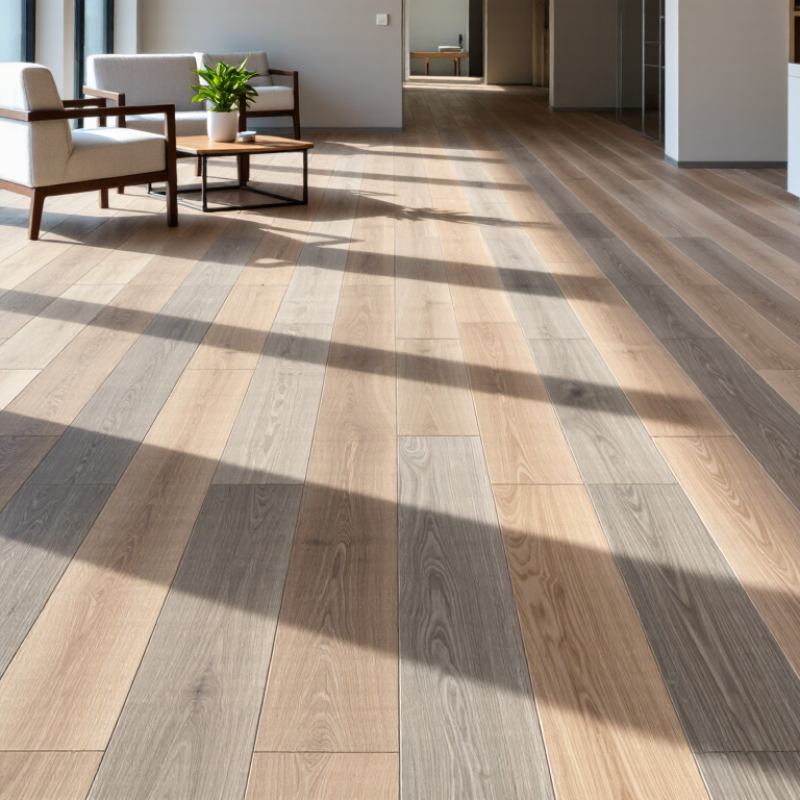
Look at a cut edge. Many WPC planks have a transparent wear layer, a printed décor film, a rigid wood-polymer composite core, and an attached or separate backing pad. The top layer protects the pattern from everyday scuffs; the core provides thickness and rigidity. Still, layer quality and composition vary. “WPC” alone tells you little about wear resistance or installation limits.

Market data provides context, not a product verdict. Grand View Research estimated the global resilient flooring market at USD 38.59 billion in 2022, with projected growth of 6.1% annually from 2023 to 2030. That figure covers resilient flooring broadly, not WPC alone. For buyers comparing manufacturers, request ASTM F3261-related test details, wear-layer thickness, and installation guidance. A specification sheet matters. So does the fine print.

How to Rank 10 Manufacturers: Capacity, Export Reach, and Quality Systems

A useful ranking starts with verified output, not a factory’s headline capacity. Ask for monthly WPC production, line count, shift pattern, and recent utilization. Then compare those figures with shipment records and repeat-order evidence. Grand View Research valued the global flooring market at USD 398.4 billion in 2023 and forecast 5.6% annual growth through 2030. This broad market figure is not a WPC forecast, but it shows why dependable supply matters. Capacity without stable delivery is just a number.

Export reach needs evidence too. Check the share of overseas sales, destination markets, lead times, and the ability to prepare consistent export documents. Request references from buyers in comparable climates; temperature swings can expose weak locking joints or poor dimensional stability. Still, paperwork can mislead. A long destination list does not prove repeat business, so weigh recent shipment records more heavily than marketing claims.

Quality systems should be tested against actual product controls. ISO 9001 certification indicates a documented management system, not flawless flooring. Ask for batch traceability, inspection records, and independent test reports covering wear layer, dimensional stability, and emissions. ASTM F3261 specifies requirements for resilient flooring in modular formats with rigid polymeric cores, making it a useful reference point for WPC products. Compare samples from different production batches. Small shade changes matter. A ranking should reward manufacturers that can explain failures, corrective actions, and retest results—not only those with polished certificates.

Top 10 WPC Flooring Manufacturers for Global Buyers — How to Rank 10 Manufacturers: Capacity, Export Reach, and Quality Systems

Use this evidence-based scoring framework to compare ten shortlisted manufacturers. It is a ranking rubric, not a claim that any unnamed supplier has been independently audited. Award points only against current, verifiable records; apply the same checks to every supplier.

Rank Evaluation Dimension Weight How to Score Evidence to Request or Verify
1 Verified Production Capacity 15 points Score documented annual output of the relevant WPC flooring product, not total facility capacity across unrelated products. Compare capacity with the buyer’s forecast volume and requested delivery schedule. Current production records, line-level capacity breakdown, product specifications, and an independently verifiable factory audit.
2 Production Resilience 5 points Assess the number of suitable production lines, maintenance arrangements, backup plans, and the supplier’s ability to manage peak demand without compromising agreed lead times. Production-line list, maintenance records, capacity-planning process, and documented business-continuity procedures.
3 Export Reach and Experience 15 points Evaluate documented shipments to the buyer’s destination markets, relevant product experience, and ability to meet local packaging, labeling, and import-document requirements. Redacted bills of lading or export declarations, destination-market references, and recent customer references, subject to verification.
4 Export Documentation and Compliance 5 points Check whether the supplier can provide accurate, consistent commercial and shipping documents and support the buyer’s destination-specific compliance process. Sample commercial invoice, packing list, certificate-of-origin process, product declarations, and destination-specific documentation checklist.
5 Quality Management System 15 points Give credit for a current, independently verifiable quality-management certificate whose scope covers the relevant manufacturing site and activities. Certification supports process evaluation but does not by itself prove product performance. Certificate, issuing body, validity dates, site address, scope, and verification through the certification body or its official directory. ISO 9001 is a quality-management-system standard.
6 Product Test Evidence 15 points Assess current test reports for the exact product construction and configuration offered. Check that the methods and reported results match the buyer’s application and destination-market requirements. Full reports from a competent laboratory, sample identification, test dates, product construction, and applicable test methods or market requirements.
7 Batch Consistency and Traceability 10 points Evaluate incoming-material controls, in-process checks, finished-product inspection, batch identification, retained samples, and the process for handling nonconforming products. Inspection plans, sample quality records, lot-coding examples, corrective-action records, and a traceability demonstration from batch to shipment.
8 Product Range and Customization 5 points Compare the documented WPC flooring range with the buyer’s requirements, including construction, dimensions, wear-layer options, surface finishes, and available installation systems. Current technical datasheets, product samples, configuration options, and written confirmation of which specifications are standard versus customized.
9 Warranty and After-Sales Support 5 points Review the written warranty’s coverage, exclusions, claim process, and duration. Compare like-for-like terms and confirm that the warranty applies in the buyer’s market. Current warranty document, claims procedure, named support contacts, and examples of how product complaints are investigated and resolved.
10 Supply-Chain and Environmental Documentation 5 points Assess the availability and scope of relevant material, environmental, and supply-chain documentation. Do not treat an environmental claim or certificate as proof unless its scope and validity are verified. Material declarations, applicable environmental documentation, certificate scope and validity, and written information on sourcing and production controls.
Total Available Score 100 points Rank the ten shortlisted manufacturers by verified total score. Record missing or expired evidence as unverified rather than assuming compliance.

Top 10 WPC Flooring Manufacturers: Product Range and Global Market Presence

A useful comparison of ten WPC flooring manufacturers looks beyond catalog size. It checks whether each supplier offers indoor planks, outdoor decking, or both. Product details matter. Buyers should compare plank thickness, wear-layer options, surface textures, locking systems, and available colors. A realistic sample can reveal more than a glossy photograph: inspect the edge profile, click joint, and finish under direct light. Ask how the product performs in humid rooms or strong sun, and request test documents that match the exact product line. “Waterproof” is not a complete specification.

Global market presence is more than a map of export destinations. Check whether a manufacturer serves your region consistently, keeps common designs available, and provides clear installation and care documents. Shipping lead times, carton labeling, and replacement-stock access can affect a project as much as the floor itself. A large range may look reassuring, yet too many near-identical styles can make selection harder. Country lists also do not prove dependable service. Compare responses to technical questions and confirm warranty terms in writing before ordering. Small details often decide whether a product suits a local project.

Product Benchmarks: Common 4–8 mm Thickness and 12–20 mil Wear Layers

For WPC flooring, 4–8 mm usually describes the plank’s total thickness, but buyers should confirm how each supplier measures it. A 4 mm plank may suit a level renovation where door clearance is tight. An 8 mm option can feel more substantial, though it may require adjusted transitions. Thicker does not automatically mean better. Check whether the quoted figure includes the attached underlay.

A 12–20 mil wear layer is another useful comparison point; one mil equals 0.001 inch. Around 12 mil may fit lighter residential use, while 20 mil is often considered for busier rooms. Still, wear-layer thickness alone cannot predict scratch performance. Surface treatment, locking design, and subfloor preparation matter too. Ask for technical data and a sample, then inspect the edge, click joint, and surface under angled light. I would not judge the floor from a brochure alone. A sample can feel firm on a desk yet sound hollow after installation. Small details matter. Also compare test methods and warranty conditions across suppliers; matching numbers do not always mean matching performance.

Buyer Due Diligence: ASTM F3261, FloorScore, and Emissions Compliance

ASTM F3261 provides a performance framework for modular resilient flooring, including relevant WPC products. Ask suppliers for a current test report tied to the exact product code, not merely a general catalog. Check dimensions, wear-layer details, and stated test results against the shipment specification. A standard reference alone does not prove every model was tested. Small mismatch, big headache.

FloorScore addresses indoor-air emissions, not durability or installation quality. Confirm the certificate is current and covers the exact flooring construction. Review installation adhesives separately, since they can affect indoor emissions too. The U.S. EPA reports that concentrations of some indoor pollutants are often two to five times outdoor levels, and can sometimes exceed them by more than 100 times. That broad estimate is not a prediction for a specific room, but it supports careful emissions screening.

Tips: Request the full certificate, product scope, and test date. Compare the certificate’s product name with packaging and purchase documents. Ask whether results follow the applicable CDPH Standard Method, often referenced in FloorScore documentation. Keep records for each production lot. A certificate is helpful, not magic; ventilation, site conditions, and installation materials still matter. If a supplier cannot clarify a discrepancy, pause before approving the order.

Top 10 WPC Flooring Manufacturers for Global Buyers

Buyer Due Diligence: ASTM F3261, FloorScore, and Emissions Compliance

How to read this chart: Bars count example verification items in a buyer-created checklist; they are not official scores or requirements set by a standard or certification program. ASTM F3261 is a product specification for resilient flooring in modular format with a rigid polymeric core. FloorScore addresses indoor air emissions. Verify that documents apply to the exact product construction and manufacturing site being offered.

  • ASTM F3261 (4): cited edition, product scope and format, declared classification or performance claims, and matching test documentation.
  • FloorScore (3): certificate validity, covered product or product family, and matching manufacturing-site scope.
  • Emissions test file (4): test method and version, tested product assembly, sample and report traceability, and reported results.
  • Supply-chain traceability (3): factory identity, production-lot identification, and change-control records for product construction.